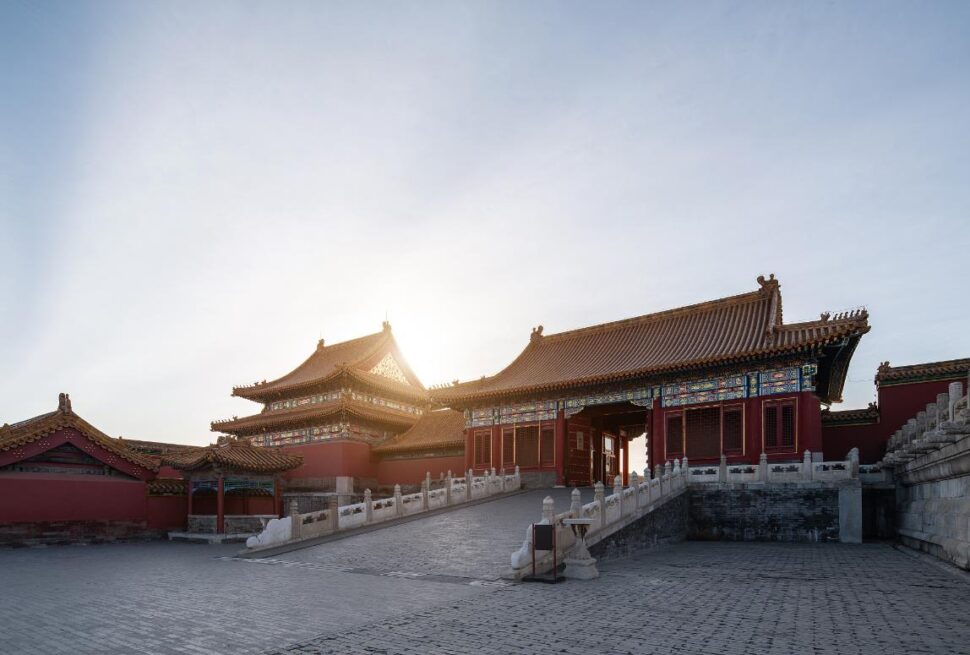
The building regulations of the Hall of Supreme Harmony in the Imperial Palace are extremely magnificent and exquisite. The following is a detailed analysis of the building regulations:
First, position and status
Location: The Hall of Supreme Harmony, located in a prominent position on the north-south main axis of the Forbidden City in Beijing, is the largest and highest-grade building in the Forbidden City.
Status: The Hall of Supreme Harmony was the place where the emperors of the Ming and Qing dynasties held major ceremonies, such as the emperor’s enthronement, wedding, conferring the empress, and ordering the emperor to go on a campaign, symbolizing the supremacy of imperial power.
Second, building scale and shape
Scale: The Hall of Supreme Harmony is 11 rooms wide and 5 rooms deep, 64 meters long and 37 meters wide, with a construction area of about 2377 square meters and a total height of 35.05 meters along with the base. It is the largest wooden structure hall in China.
Shape: The Hall of Supreme Harmony adopts the double eaves, the roof is covered with yellow glazed tiles, and 10 animals are placed in the corners of the eaves, the number of which is only seen in the existing ancient buildings, reflecting the highest regulation of ancient Chinese architecture.
Third, architectural structure and decoration
Pedestal: The Hall of Supreme Harmony is located on a three-layer white jade pedestal with a height of 8.13 meters. Each pedestal has exquisite carvings and the form of a sumi seat, symbolizing the honor and majesty of the royal family.
Beams and columns: The Hall of Supreme Harmony has a total of 72 large columns, of which six are dragon wrapped gold columns, with a diameter of 1 meter, supporting the weight of the entire hall. The beams and columns are decorated with and seal color paintings, exquisite patterns and brilliant colors.
Dougong: Dougong set under the eaves is dense, which not only has a load-bearing effect, but also adds to the beauty of the building.
Doors and Windows: the upper part of the doors and Windows are inlaid with diamond plaid pattern, the lower part is embossed with cloud dragon pattern, and the joint is installed with gilt bronze leaves engraved with dragon pattern, highlighting the royal style.
Caisson: The ceiling is placed in the middle of the temple caisson, caisson is carved in the middle of the pan lying dragon, the head of the probe, the mouth of the treasure beads, decorated around the cloud dragon pattern, resplenent.
Fourth, special structure and symbolic significance
Throne: There is a gold-lacquered cloud dragon throne in the Hall of Supreme Peace, and six giant columns with gold cloud dragon patterns are arranged on both sides of the throne. The Qianlong Emperor’s imperial title “Jianji Suiyou” plaque is hung above the throne, and the Qianlong Emperor’s imperial title couplets are hung on both sides of the columns, symbolizing the supremacy of imperial power.
Regulus mirror: The jewel in the sunken well above the throne is called “Regulus mirror”, and folklore says that if a person who is not ordered by heaven sits on the throne, the regulus mirror will fall down, killing that person. This legend adds to the mystery of the Hall of Supreme Harmony.
Furnishings: There are four pairs of furnishings on both sides of the throne, including elephant, luduan, crane, incense pavilion, etc., respectively symbolizing the stability of the country, the consolidation of the political power, longevity and stability of the country.
Fifth, historical evolution
First built and renamed: The Hall of Supreme Harmony was built in the 18th year of Yongle in the Ming Dynasty (1420), and was originally named Fengtian Hall. In the forty-first year of Jiajing in the Ming Dynasty (1562), it was renamed Huangji Hall, and in the second year of Shunzhi in the Qing Dynasty (1645), it was renamed Taihe Hall.
Reconstruction and restoration: The Hall of Supreme Harmony has suffered many fires and other disasters in history, but it has been rebuilt or repaired every time. The existing building was rebuilt in 1695 in the 34th year of Kangxi of the Qing Dynasty.
Sixth, architectural characteristics summary
The building regulation of the Hall of Supreme Harmony embodies the highest level of ancient Chinese architecture, which is grand in scale, exquisite in shape, luxurious in decoration and far-reaching in symbolic significance. The Hall of Supreme Harmony is not only an outstanding representative of ancient Chinese palace architecture, but also an important part of the world cultural heritage.